✨ This article was AI edited. Editorial responsibility: CoolestHoodies.com.
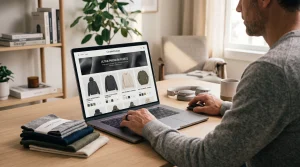
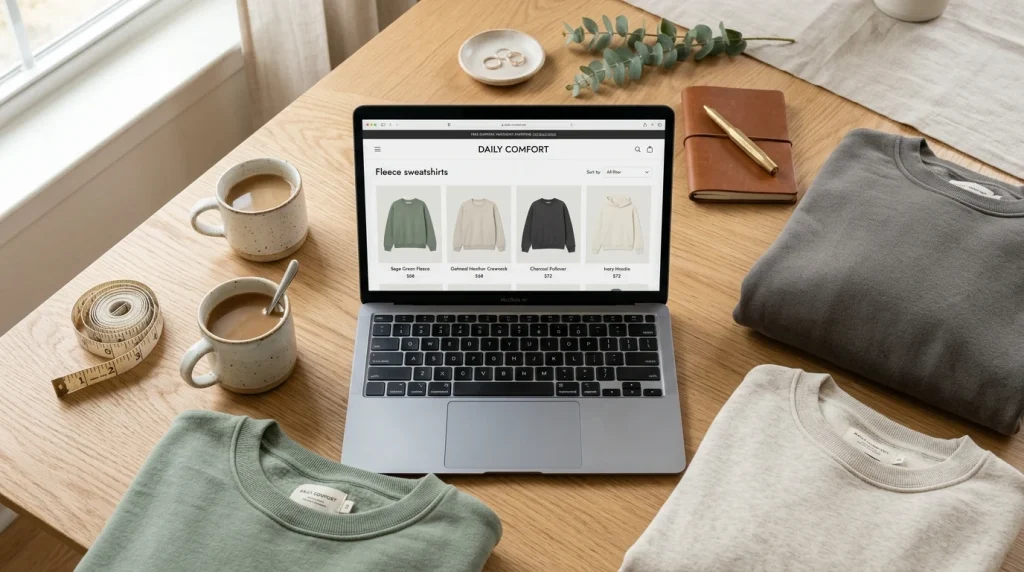
Buying sweatshirts online offers access to an unmatched variety of streetwear silhouettes, heavyweight vintage reproductions, and technical fleece fabrics. However, ordering without trying a garment on frequently leads to disappointing surprises: sleeves that run short after a single laundry wash, boxy shoulders that swallow your frame, or synthetic polyester that feels like plastic rather than soft brushed cotton.
To avoid costly return shipping fees and garment disappointment, successful online shopping requires reading spec sheets rather than relying on promotional lifestyle photos. Below is the comprehensive technical buyer’s protocol for evaluating fabric composition, sizing charts, construction standards, and return guarantees before checking out.
1. Decoding Fabric Composition and Fleece Class
The product description’s fiber breakdown determines how warm the sweatshirt will feel, how it will drape, and how much it will shrink over time.
| Fiber Blend | Tactile Feel & Drape | Thermal Performance | Shrinkage Expectation | Ideal Use Case |
|---|---|---|---|---|
| 100% Ring-Spun Cotton | Dense, substantial, natural breathability, softens with age | High breathability, moderate wind resistance | 3% to 6% in warm water wash | Heritage streetwear, premium loungewear, daily indoor comfort |
| 80% Cotton / 20% Polyester | Plush interior fleece loft, balanced structure | Excellent thermal retention without excess weight | Minimal (1% to 2%) | Active outdoor wear, durable athletic training, versatile layering |
| 50% Cotton / 50% Polyester | Smooth outer shell, lightweight, resistant to wrinkles | Quick-drying, moderate insulation | Zero shrinkage | Budget workwear blanks, high-intensity workouts, graphic merch |
| 100% Synthetic Polyester | Silky, slick, non-porous exterior; zero natural fuzz | Traps moisture; prone to static cling | 0% (Heat sensitive in dryers) | Specialty sublimation graphics, rain-resistant utility outerwear |
Yarn Quality: Ring-Spun vs. Open-End Carded Cotton
Beyond the fiber percentage, look for the yarn spinning method:
- Combed and Ring-Spun Cotton: The raw cotton fibers are continuously combed to remove short, scratchy fibers, then tightly twisted into fine, strong yarn. Sweatshirts made from ring-spun cotton feel exceptionally soft, resist surface pilling, and maintain a smooth, uniform face for years.
- Open-End (Carded) Cotton: A faster, lower-cost spinning process that leaves fiber ends pointing in random directions. While it produces a crisp, dry vintage workwear hand-feel, it pills much faster under friction and feels noticeably coarser against bare skin.
2. The Three Critical Measurements: How to Measure at Home
Never choose an online sweatshirt size based purely on letter sizing (S, M, L, XL). A size Medium from a Japanese streetwear label often fits like an American size Small, while an American workwear brand’s Medium fits like a traditional Large.
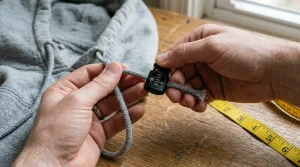
Instead, lay your best-fitting sweatshirt flat on a table, smooth out wrinkles, and measure three key dimensions using a flexible cloth tape measure:
- Chest Width (Pit-to-Pit): Measure straight across the chest from the lower armpit seam to the opposite armpit seam, roughly 1 inch below the sleeve join. Multiply by 2 for total chest circumference.
- Body Length (High Point Shoulder): Measure from the highest point of the shoulder seam where it meets the neck rib down in a vertical straight line to the very bottom edge of the waistband ribbing.
- Sleeve Length (Center Back Neck to Cuff): Place the tape measure at the center back of the neckline collar, extend it across the top shoulder seam, and run it straight down the outer arm to the end of the wrist cuff.
Compare these numbers against the merchant’s published “Garment Specification Table” rather than their generic “Body Size Guide”. For accurate scale conversions across sizing tiers, consult our breakdown of how much does a sweatshirt weigh.
International Sizing Reference Chart
| US / Canadian Standard | UK / Australian Standard | European Union (EU) | Asian Standard (Japan / Korea) |
|---|---|---|---|
| Small (S) – 36–38″ Chest | 36–38″ (S) | 46 – 48 | Medium (M) |
| Medium (M) – 40–42″ Chest | 40–42″ (M) | 50 – 52 | Large (L) |
| Large (L) – 44–46″ Chest | 44–46″ (L) | 54 – 56 | X-Large (XL) |
| X-Large (XL) – 48–50″ Chest | 48–50″ (XL) | 58 – 60 | 2X-Large (2XL) |
3. Construction Quality Indicators to Inspect in Product Photos
Reputable online apparel retailers provide high-resolution zoom capabilities. Inspect these four construction telltales before buying:
- Flatlock Seaming vs. Overlock: Flatlock seams join two fabric panels edge-to-edge with flat, visible cross-stitching on both sides. This eliminates bulky internal ridges that chafe against skin during prolonged wear. Overlock seams leave an exposed chain-stitch seam inside the garment.
- Ribbed Side Gussets: High-end sweatshirts (such as reverse weave patterns) feature vertical ribbed elastic panels along the side torso. These stretch gussets allow unrestricted torso mobility while preventing the sweatshirt from shrinking lengthwise in the wash.
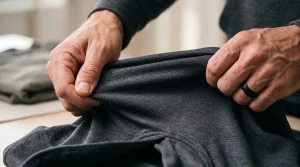
- Spandex / Lycra Rib Cuffs: Check if the collar, wrist cuffs, and bottom hem contain 3% to 5% elastane or spandex. 100% cotton ribs quickly stretch out and become loose after just a few hours of wear, while elastane-infused ribbing snaps back firmly into shape.
- Neckline Reinforcement Tape: Quality manufacturers cover the raw seam allowance inside the back collar with a sewn strip of woven cotton twill tape. This prevents the collar from stretching into an unkempt wavy neckline over repeated cycles.
4. E-Commerce Return Policies: Protecting Your Purchase
Before entering your credit card details, verify the retailer’s return conditions:
| Return Feature | Standard Consumer Safe | Red Flag / Warning Sign |
|---|---|---|
| Window Duration | 30 days from delivery date | 7 days or “final sale upon delivery” |
| Return Shipping Cost | Prepaid label provided or deducted flat fee ($6–$8) | Customer must ship to an overseas warehouse in Asia at own expense ($35+) |
| Restocking Deductions | $0 restocking fees on unworn apparel | 15% to 25% restocking penalty deducted from refund |
| Refund Method | Full refund to original payment source | Store credit or digital coupon only |
5. Frequently Asked Questions
What fabric weight should I look for in an everyday sweatshirt?
For everyday indoor and three-season comfort, aim for a midweight fleece between 300 and 380 GSM (8.5 to 11 oz/yd²). This weight provides satisfying substantial drape without causing overheating in heated indoor environments.
How do I know if an online sweatshirt will shrink?
Look for the terms “pre-shrunk”, “garment-dyed”, or “washed finish” in the product copy. Garment-dyed sweatshirts have already undergone industrial high-heat wash cycles during production, reducing future shrinkage to less than 1%. If the item is raw 100% unwashed cotton, expect 3% to 6% shrinkage in length.
Should I size up when buying a pullover hoodie online?
If the hoodie has a high cotton percentage (over 80%) and you intend to dry it in an electric dryer, sizing up one step provides comfortable insurance against shrinkage. For fitted streetwear styling worn under tailored jackets, stick to true-to-size based on pit-to-pit measurements.
Post-Delivery Care and Garment Preservation
When your parcel arrives, try the sweatshirt on immediately before removing manufacturer tags. Check shoulder alignment and cuff tightness. Once verified, wash inside out in cold water on a gentle spin cycle to preserve fleece softness. To prevent shoulder distortion and keep your sweatshirt looking sharp season after season, see our guide on whether you should hang or fold hoodies.
Get our latest guides, news, and insights highlighted in your Google Search & AI Overviews.