✨ This article was AI edited. Editorial responsibility: CoolestHoodies.com.
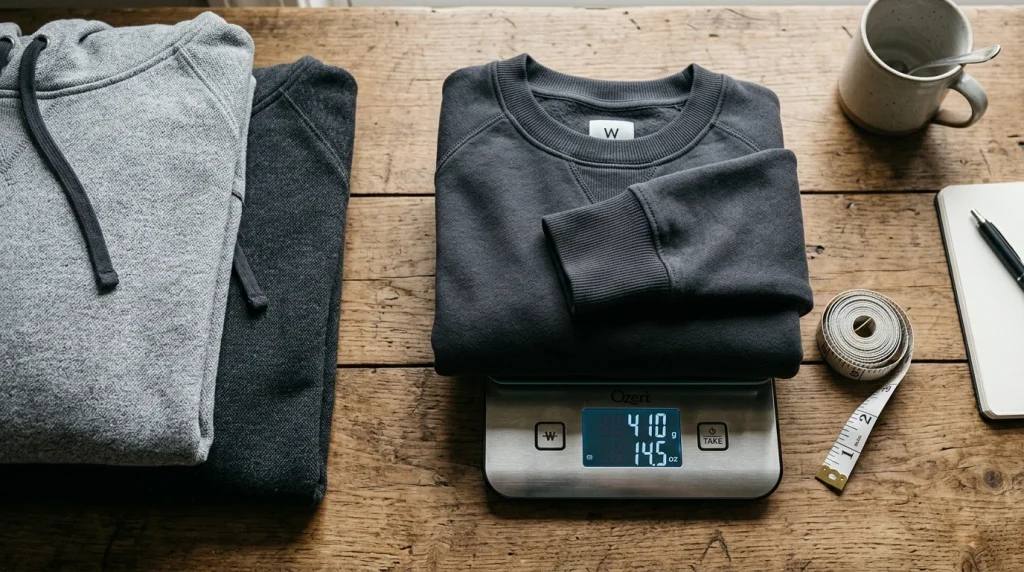
An average adult sweatshirt weighs between 14 and 24 ounces (400 to 680 grams), or roughly 0.88 to 1.5 pounds. The exact weight depends primarily on fabric density measured in GSM (grams per square meter), garment construction (crewneck pullover versus hooded sweatshirt with hardware), and garment size.
Understanding exact sweatshirt weight is critical whether you are calculating e-commerce shipping postage, packing luggage under airline limits, or choosing between a breezy transitional layer and a rugged winter fleece. Below are the definitive weight benchmarks categorized by fabric class, sizing scale, and shipping thresholds.
Sweatshirt Weight Tiers by Fabric Density (GSM)
Textile mills categorize sweatshirt fleece according to fabric weight per area, commonly cited in ounces per square yard (oz/yd²) or grams per square meter (GSM). Here is how standard adult medium (M) sweatshirts break down:
| Fabric Category | Fabric Weight (oz/yd² / GSM) | Average Garment Weight (Ounces) | Average Garment Weight (Grams) | Typical Example / Use Case |
|---|---|---|---|---|
| Lightweight Fleece | 6.5 – 7.5 oz/yd² (220 – 250 GSM) | 10.0 – 14.5 oz | 280 – 410 g | Summer evening layers, French terry crewnecks, tri-blend gym pullovers |
| Midweight Fleece | 8.0 – 9.5 oz/yd² (270 – 320 GSM) | 15.0 – 21.0 oz | 425 – 595 g | Standard streetwear hoodies, Gildan 18000/18500, Bella+Canvas 3719 |
| Heavyweight Fleece | 10.0 – 13.5 oz/yd² (340 – 450 GSM) | 22.0 – 29.0 oz | 620 – 820 g | Champion Reverse Weave, Carhartt Midweight, Independent Trading IND4000 |
| Ultra-Heavyweight Fleece | 14.0 – 18.0+ oz/yd² (475 – 600+ GSM) | 30.0 – 40.0+ oz | 850 – 1,150+ g | Camber 441/232 Cross-Knit, House of Blanks, premium luxury street labels |
Brand-by-Brand Garment Weight Benchmarks (Size L Pullover)
To help online sellers and buyers calibrate exact weights without owning a digital fabric scale, here is empirical data measured across the most popular wholesale blanks and commercial apparel brands:
| Brand & Model | Stated Fabric Spec | Actual Garment Weight (oz) | Actual Garment Weight (g) | Shipping Classification |
|---|---|---|---|---|
| Gildan Heavy Blend 18500 | 8.0 oz/yd² (271 GSM) 50/50 Cotton/Poly | 18.4 oz | 522 g | Parcel Tier (1 lb 2.4 oz) |
| Bella+Canvas 3719 Sponge Fleece | 7.0 oz/yd² (240 GSM) 52/48 Blend | 14.8 oz | 420 g | Under 1 lb in thin polymailer |
| Independent Trading IND4000 | 10.0 oz/yd² (330 GSM) 80/20 Cotton/Poly | 22.6 oz | 641 g | 2 lb Shipping Tier |
| Champion Reverse Weave S101 | 12.0 oz/yd² (405 GSM) Heavyweight Cross-Grain | 27.8 oz | 788 g | 2 lb Shipping Tier |
| Carhartt Midweight K121 Hooded | 10.5 oz/yd² (356 GSM) 50/50 Blend | 26.2 oz | 743 g | 2 lb Shipping Tier |
| Camber USA 441 Cross-Knit | 12.0 oz/yd² Heavy Outer (Double thick) | 36.5 oz | 1,035 g | 3 lb Shipping Tier |
| Los Angeles Apparel HF-09 | 14.0 oz/yd² (475 GSM) 100% US Cotton | 31.2 oz | 885 g | 2 lb+ Boxed Parcel |
Crewneck vs. Pullover Hoodie vs. Zip-Up: What Adds Weight?
Garment style and construction details significantly influence the overall scale reading:
- Crewneck Pullovers: The lightest format. Without hood fabric, drawstring eyelets, or kangaroo pockets, crewnecks shave 3 to 6 ounces off identical-fabric hoodies. An average medium midweight crewneck weighs approximately 14 to 16 ounces (395 to 450 grams).
- Pullover Hoodies: The double-lined hood adds substantial fabric area, while front pouch pockets and metal eyelets add another 4 to 8 ounces. A standard medium midweight hoodie weighs approximately 18 to 22 ounces (510 to 625 grams).
- Full-Zip Hoodies: Heavy brass or metal separating zippers add 1.5 to 3.5 ounces compared to pullover styles. If you are modifying a pullover using our guide on putting a zipper on a hoodie, factor in the weight of your chosen #5 or #8 metal zipper tape.
Sweatshirt Weight Variance by Size Scale
As garment dimensions increase from size Small to 3XL, the surface area of fabric expands proportionally. For a midweight (8.5 oz / 290 GSM) pullover hoodie, average weights scale as follows:
| Size | Approximate Weight (oz) | Approximate Weight (g) | Postal Tier Impact (Under 16 oz vs 1 lb+) |
|---|---|---|---|
| Small (S) | 17.0 – 18.5 oz | 480 – 525 g | Over 1 lb (Requires 1–2 lb parcel tier) |
| Medium (M) | 18.5 – 20.5 oz | 525 – 580 g | Over 1 lb |
| Large (L) | 20.5 – 22.5 oz | 580 – 640 g | Over 1 lb |
| X-Large (XL) | 22.5 – 25.0 oz | 640 – 710 g | Over 1 lb |
| 2X-Large (2XL) | 25.0 – 28.0 oz | 710 – 795 g | Requires 2 lb tier in polymailer |
| 3X-Large (3XL) | 28.0 – 31.0 oz | 795 – 880 g | Requires 2 lb tier in polymailer |
E-Commerce and Postal Shipping Considerations
For online apparel retailers and shipping calculations, packaging materials (polymailers weigh ~0.5 oz, corrugated boxes weigh 6 to 12 oz) must be added to the garment weight:
- First Class / Ground Advantage 16 oz Threshold: Only lightweight crewnecks (under 240 GSM in sizes XS–M) packed in ultra-thin 10×13 polymailers will stay under the strict 1-pound (15.99 oz) USPS threshold.
- Standard Parcel Rates: Almost all midweight and heavyweight adult hoodies in polymailers fall between 1 lb 2 oz and 1 lb 12 oz, requiring the 2 lb rate tier.
- Heavyweight Winter Outerwear: 400+ GSM heavyweight sweatshirts packed in cardboard shipping boxes consistently register between 2.2 and 3.0 pounds total shipping weight.
How Washing and Fabric Retention Alter Garment Weight
Cotton fleece is hygroscopic, meaning it absorbs moisture directly from ambient humidity. A heavyweight hoodie stored in an unconditioned, humid basement can absorb 1 to 2 ounces of moisture weight compared to the same garment kept in dry, heated living quarters.
Furthermore, when soaked in a washing machine, a heavyweight hoodie absorbs up to 300% of its dry weight in water (weighing upwards of 5 to 7 pounds when fully saturated). High-speed spin cycles (1000+ RPM) extract approximately 80% of this absorbed water, but hanging a dripping wet sweatshirt can permanently deform shoulder seams and stretch the torso lengthwise by several inches. Always support wet garments horizontally when drying.
Frequently Asked Questions
What is the difference between fabric oz and garment weight?
Fabric ounces (e.g., “8.5 oz hoodie”) refer to the weight of a square yard of that fabric (oz/yd²), not the total weight of the finished clothing item. A finished size Large hoodie made from 8.5 oz/yd² fabric requires approximately 2.5 yards of fabric, resulting in a total garment scale weight of roughly 21 to 22 ounces.
Do graphic prints and embroidery add noticeable weight?
Standard screen prints add negligible weight (less than 0.2 ounces). However, massive direct-to-film (DTF) plastic transfer sheets and high-density, multi-layer direct embroidery patches on the chest and back can add 1.5 to 3.0 ounces of solid thread and stabilizer backing.
What scale should I use to weigh sweatshirts for shipping?
Use a digital postal scale with a capacity of at least 10 pounds (5 kg) and a precision resolution of 0.1 ounces (1 gram). Avoid using mechanical bathroom scales, which often lack the sensitivity required to distinguish between a 15.8 oz package (eligible for under-1-lb rates) and a 16.2 oz parcel (which incurs the next pound rate tier).
Storage Implications for Heavy Sweatshirts
Garment weight directly affects how you store your collection. Heavyweight sweatshirts exceeding 20 ounces exert continuous downward gravitational strain on shoulder seams when hung on thin wire or plastic hangers. To prevent distorted “hanger bumps” and preserve garment structure over multiple seasons, review our detailed guide on whether you should hang or fold hoodies.
Get our latest guides, news, and insights highlighted in your Google Search & AI Overviews.