✨ This article was AI edited. Editorial responsibility: CoolestHoodies.com.
Produced with AI. This article was artificially generated. Editorial responsibility: CoolestHoodies.com.
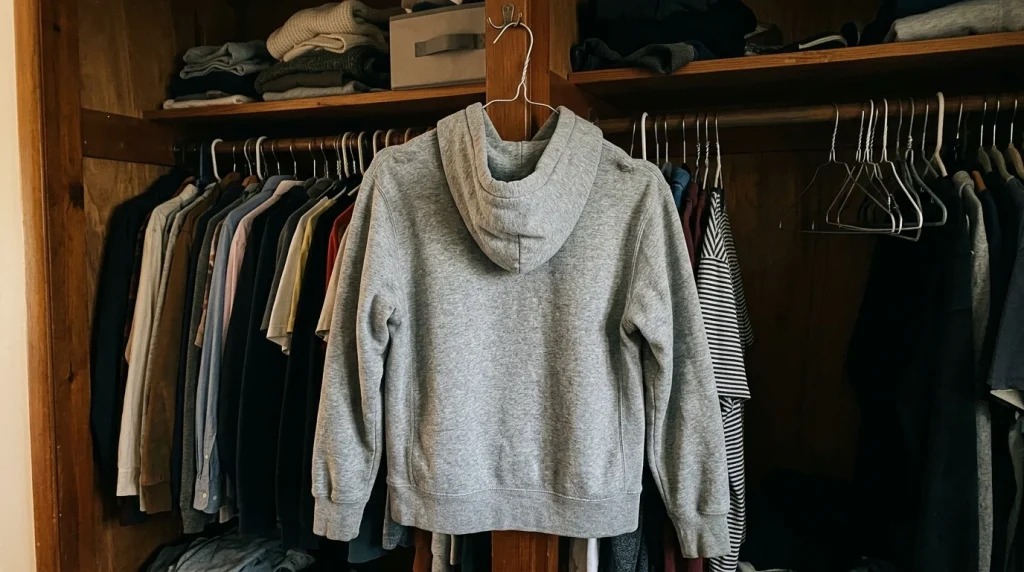
Does hanging hoodies stretch them? Yes, hanging heavy cotton hoodies on standard wire or plastic hangers permanently stretches shoulder seams and distorts the fabric weave. Gravitational pull on dense knit fleece causes severe shoulder puckering, neck sagging, and vertical silhouette elongation, making horizontal folding the recommended preservation method.
Why Hanging Stretches and Distorts Hoodie Fabrics
Every hooded sweatshirt possesses substantial fabric mass concentrated around the hood, collar, and chest fleece. Unlike lightweight woven shirts made from warp-and-weft poplin or linen, hoodies are constructed with looped circular knit textiles—predominantly French terry or brushed fleece blends containing cotton and polyester. Knit textiles achieve their soft hand feel and thermal retention through elastic yarn loops rather than rigid thread interlocks.
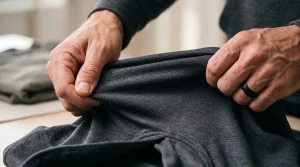
When placed vertically on a narrow hanger, the entire weight of the garment rests on two narrow pressure points roughly three to four inches wide across the acromion region of the shoulders. Over 48 to 72 hours of vertical suspension, the gravitational load forces the knitted yarn loops to uncoil and elongate vertically. This physical deformation results in prominent, irreversible conical bulges commonly referred to in textile preservation as “hanger wings” or “shoulder horns.”
Moreover, the heavy hood structure hangs unsupported behind the garment, continuously exerting downward leverage against the back collar band. This persistent tensile strain causes the neckline ribbing to sag downward, permanently warping the circular crew collar into a loose, unkempt oval.
Textile Mechanics: Knit Fleece vs. Gravitational Load
Understanding the microstructural difference between fiber compositions helps illustrate why certain hoodies stretch faster than others when hung in a closet:
| Fabric Composition | Tensile Elastic Recovery | Deformation Risk on Hanger | Optimal Storage Method |
|---|---|---|---|
| 100% Heavyweight Cotton (400–500 GSM) | Low (Prone to permanent plastic deformation) | Critical (Extremely high stretching within 48h) | Flat shelf fold or roll |
| Cotton-Polyester Blend (80/20 or 70/30) | Moderate (Polyester core provides slight rebound) | High (Shoulder wings form over 1–2 weeks) | Folded or padded broad hanger |
| French Terry Loopback Cotton | Low-to-Medium (Long loop tension unravels vertically) | High (Elongates total body length by 1–2 inches) | Horizontal shelf stacking |
| Fleece with Spandex / Elastane (2–5%) | High (Active elastic memory) | Moderate (Recovers after wash, but neck stretches) | Folded or draped crossbar fold |
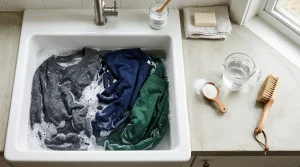
As documented in textile engineering standards, wet fibers carry double the tensile susceptibility of dry fibers. Hanging a freshly washed, damp hoodie to air-dry on a wire hanger is the single most common cause of irreversible hem drop and neck distortion. The water held within the cellular lumens of cotton fibers adds up to three times the dry weight of the garment, magnifying downward force exponentially.
Hanger Types Ranked by Fabric Damage Risk
If closet space constraints make hanging unavoidable, selecting the correct support hardware is paramount. Not all hangers exert identical focal pressure upon garment seams:
- Wire Hangers (Dry Cleaner Style): The highest risk category. With a contact surface width under 2 millimeters, wire hangers concentrate pounds of downward load onto microscopic fiber bundles, cutting into shoulder seams and producing severe shoulder peaks within 24 hours.
- Standard Tubular Plastic Hangers: Common yet problematic. While slightly wider than wire (approximately 8 millimeters), standard plastic hangers terminate in sharp outer drop angles that fail to mirror the natural ergonomic slope of the human trapezius and clavicle.
- Slim Velvet Non-Slip Hangers: Excellent for silk blouses and tailored shirts, but detrimental for heavy cotton fleece. The high-friction flocked surface prevents the fabric from shifting naturally, anchoring weight unevenly across the yoke and accelerating neckline stretching.
- Wide Contoured Wooden Coat Hangers (1.5″–2″ Shoulders): The only acceptable traditional hanger for hoodies. Thick rounded cedar or beechwood hangers distribute gravitational weight across the full shoulder span, minimizing pressure hotspots.
The Crossbar Folding Method (The Retail Trick)
If closet hanging space is your only option, professional clothiers and vintage garment curators employ the Sweater Hanger Fold (also known as the modified diagonal fold). This zero-tension hanging technique suspends the hoodie over a wooden hanger bar without placing any stress on the shoulders or neckline:
- Lay Flat: Lay your hoodie face-down on a clean, smooth surface (such as a bed or table), smoothing out all wrinkles from hem to collar.
- Fold in Half: Fold the hoodie vertically in half lengthwise, bringing the left sleeve and left half of the body directly over the right half, creating a neat symmetrical silhouette.
- Position the Hanger: Place the hanger flat on top of the folded hoodie, orienting the hook inside the armpit crook with the triangular base pointing toward the hem.
- Drape the Body: Fold the bottom half of the hoodie body up and over the horizontal crossbar of the hanger, pulling the hem through smoothly.
- Drape the Sleeves: Fold the sleeves over the opposite shoulder bar of the hanger, draping them down alongside the body.
With this method, the gravitational weight is evenly supported across the garment’s horizontal center of mass, completely eliminating point-pressure on the collar, shoulders, and cuffs.
How to Reverse Shoulder Bumps and Stretched Seams
If hanging has already warped your favorite sweatshirt, you do not need to discard the garment. Because cotton is a cellulosic fiber with hydrogen bonding capabilities, moist heat can re-contract stretched knit loops into their original compact structure:
Method 1: Targeted Steam Reshaping
Hold a handheld garment steamer or a steam iron hovered two inches above the affected shoulder area. Do not press the hot soleplate directly into fleece, as high heat can scorch synthetic blends or flatten cotton pile. Direct dense bursts of steam into the shoulder peaks for 30 to 45 seconds until the fabric becomes warm and moist. Using your fingers, gently pat and massage the stretched fabric inward, compressing the looped knit fibers back together. Allow the hoodie to dry completely flat on a towel.
Method 2: Ice Cube Thermal Shock
For stubborn, pointed shoulder wings, rub an ice cube directly over the stretched fabric bump until the yarn is saturated with cold water. Next, use a domestic hair dryer set to high heat while holding the nozzle three inches from the wet fabric, using circular motions. As the moisture rapidly evaporates under concentrated warm airflow, the cotton cellulose tightens and contracts back to its baseline weave density.
Long-Term Fabric Care and Structural Preservation
Proper storage is merely one component of garment longevity. Daily wear patterns and handling methods interact directly with textile degradation:
When pulling a hoodie off a hanger, never grab the collar and pull abruptly upward. This common habit over-stretches the ribbed knit neckband, degrading the fine elastic threads (elastodiene core) woven into the trim. Instead, reach inside the bottom hem and slide the hanger out from underneath. For premium streetwear and collectible heavyweight garments, invest in acid-free tissue paper inserted between folds to prevent persistent fold creases from developing into permanent abrasion points over multi-month seasonal storage.
Additionally, remember that humidity accelerates stretching. High closet humidity softens the hydrogen bonds inside organic cotton cellulose, allowing fibers to yield under smaller gravitational forces. Keeping silica gel desiccant packs or cedar blocks in your wardrobe helps stabilize moisture levels around 45% to 50% relative humidity, ensuring knit garments maintain their original factory density.
Best Storage Practices: Folding vs. Stacking
For long-term garment preservation, horizontal storage remains the gold standard. When folding hooded sweatshirts for dresser drawers, shelves, or under-bed bins, adopt the following preservation protocols:
- The KonMari File Fold: Fold both sleeves across the back, fold the hood downward flat against the chest, fold each lateral side inward by two inches, and fold the bottom hem upward twice to form a freestanding rectangle. Store vertically in deep drawers to prevent bottom garments from suffering weight compression.
- Breathable Cotton Storage Bags: If storing seasonal winter hoodies during summer months, always use zippered cotton canvas storage boxes rather than airtight plastic bins. Natural cotton requires air circulation to prevent mildew, trapped odors, and fiber embrittlement.
- Cedar Blocks Over Mothballs: Protect natural cotton-wool blends with aromatic natural cedar rings rather than chemical naphthalene blocks, which leave persistent chemical residues on fleece lining.
Frequently Asked Questions About Hoodie Storage
Can I hang a zip-up hoodie instead of a pullover?
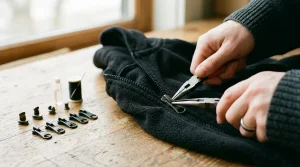
Zip-up hoodies suffer even greater hanging distortion than pullovers. The metal or molded plastic zipper teeth provide a rigid vertical spine, while the surrounding cotton fleece sags. Over time, hanging creates the dreaded ‘zipper wave’ or ‘rippling zipper effect,’ where the distorted fabric bulges outward unevenly along the zipper track.
How long can a hoodie hang before damage occurs?
On thin wire or plastic hangers, visible shoulder nipples form within 24 to 48 hours on heavyweight (350+ GSM) fleece. On wide contoured wooden hangers, light hoodies can safely hang for several weeks without structural damage, though seasonal storage should always be folded.
Does washing shrink stretched shoulders back to normal?
Yes, a standard wash cycle in warm water followed by flat air-drying will reset 90% of minor shoulder stretching in 100% cotton garments. The mechanical agitation and water immersion cause cellulose fibers to swell, relaxing the tensile strain and restoring original loop symmetry.
Get our latest guides, news, and insights highlighted in your Google Search & AI Overviews.